Sunil Bharti Mittal, 68, will retire as chairman of Airtel Africa in July after the conclusion of this year's annual general meeting (AGM), the board of the African arm of India's second-largest telecom service provider Bharti Airtel said in a statement to the exchanges on Wednesday.

Indian stock market indices Sensex and Nifty experienced a decline in early trade due to surging crude oil prices and ongoing geopolitical uncertainty in West Asia. Foreign fund outflows further contributed to the negative sentiment.

The Indian rupee rebounded against the US dollar after the Reserve Bank of India (RBI) restricted banks' net open positions in dollars. This move prompted banks to sell dollars, providing temporary support for the rupee amidst ongoing geopolitical tensions and rising oil prices.

Pakistan's skewed foreign reserves got a major boost after Saudi Arabia pledged an additional $3 billion in deposits while extending its existing $5 billion facility for a further three years.

India has voiced its deep concern over reports of increasing civilian casualties in Lebanon due to Israeli strikes, emphasising the protection of civilians and the importance of international law.

TeamLease Digital CEO Neeti Sharma discusses how AI is driving a structural reset in the tech industry, leading to layoffs, reshaping hiring practices, and increasing job insecurity.

Pakistan's Chief of Defence Forces Field Marshal Asim Munir held talks with Iranian leaders in Tehran to help resolve the conflict between the US and Iran, following a recent ceasefire agreement.

Sensex plunges over 1,400 points and Nifty slips near 22,250 amid Trump's Iran threat, rising crude oil prices, and FII selling. Here are the key reasons behind today's market crash.
Indian equities on Dalal Street saw volatility as global market trends and fresh tariff concerns linked to Donald Trump impacted investor sentiment. Track Sensex, Nifty50 movement and key market drivers for April 2, 2026.

Indian markets on Dalal Street rallied sharply as easing tensions in the US-Iran conflict and stable oil prices boosted sentiment. Track Nifty 50 and BSE Sensex performance and key global triggers.

Indian stock market indices Sensex and Nifty experienced a significant drop in early trade, reversing a three-day rally. The decline was triggered by a sharp increase in crude oil prices, weak global market trends, and continuous outflows of foreign funds.

With domestic markets turning choppy, investors are increasingly scouting for opportunities overseas to diversify portfolios and hedge against a weakening rupee.

External Affairs Minister S Jaishankar discussed the West Asia conflict's impact on the global economy, particularly energy security, with US Secretary of State Marco Rubio. He also engaged with GCC ambassadors and his Sri Lankan and German counterparts on the same issue.

The Indian IPO market is experiencing a significant surge in preliminary filings, with 38 companies submitting papers to SEBI in March 2026, driven by a combination of improved issuer confidence, strategic regulatory compliance, and private equity investors seeking exits amidst volatile market conditions.

Indian stock market indices Sensex and Nifty closed nearly 1 per cent higher, marking their third consecutive day of gains, supported by a slight decrease in crude oil prices and positive global market trends.

Union Minister Kiren Rijiju criticises Congress leader Rahul Gandhi's parliamentary conduct, accusing him of being unduly influenced by advisors and questioning his casual attire in the House.
Indian stock markets recovered from early losses to close higher, driven by value buying in IT and banking shares and a rebound in the rupee.
Indian bank credit expanded by 16.08 per cent year-on-year in FY26, marking its fastest pace since FY24, while deposits grew by 13.47 per cent, according to RBI data. Experts caution that year-end figures may be inflated due to reporting date changes, but acknowledge strong momentum in corporate, MSME, and retail segments.

Indian benchmark stock indices Sensex and Nifty rallied for the second consecutive day, closing nearly 1 per cent higher, driven by gains in metal and auto sectors and positive global market trends.

"It is quite possible that the rates will remain low in the near to medium term, but that will depend on how conditions evolve," said RBI Governor Sanjay Malhotra.

While the leadership issues may get sorted in the upcoming board meetings of Tata Trusts and Tata Sons, listing of the holding company of the Group on stock exchange should potentially resolve the bigger question on ownership and control

In the present hyper-connected world, there are many domestic and global factors that affect financial markets. Of them, the most powerful and often least predictable are geopolitical events, which often boil down to one diplomatic headline.

Prime Minister Narendra Modi has called on Indian citizens to unite and overcome the challenges posed by the ongoing conflict in West Asia, cautioning against politicisation and rumour-mongering.
Indian equity markets experienced a volatile session, with the Sensex and Nifty recovering some ground after a significant plunge the previous day. Gains were driven by PSU bank, IT, and metal stocks, but concerns over rising fuel prices and geopolitical tensions limited the recovery.
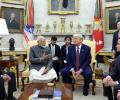
Prime Minister Narendra Modi and US President Donald Trump discussed the Middle East crisis, with a focus on the Strait of Hormuz.

The question is whether the clocks allow enough time for two deeply mistrustful sides to get there, and whether the surface calm holds long enough for the paddling to produce something before the ceasefire ends on April 22, notes Prem Panicker in his must read blog on the Iran War.

Analysts predict a surge in gold and silver prices as investors seek safe-haven assets due to escalating tensions in the Middle East. The impact on domestic prices will depend on the conflict's duration, with geopolitical factors and macroeconomic data also playing a role.

Gold prices are expected to remain volatile next week as investors track geopolitical developments in the Middle East and key macroeconomic data releases that could shape the sentiment in the domestic market, analysts said.

Prime Minister Narendra Modi convened the Cabinet Committee on Security to address the impact of the West Asia conflict on Indian citizens, focusing on safeguarding them from the conflict's effects and ensuring the smooth flow of essential supplies.

The intriguing bit is that Trump is likely to attend the talks in Islamabad this weekend -- if he does, it will be the clearest signal yet that the US is ready to exit the war with some sort of win to show, since he cannot afford to go for the talks and return empty-handed, notes Prem Panicker in his must read blog on the Iran War
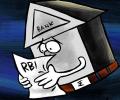
Indian banks are urging the Reserve Bank of India (RBI) to reconsider its new $100 million cap on net open foreign-exchange positions, warning that the directive could lead to significant mark-to-market (MTM) losses and force an accelerated unwinding of trades, potentially impacting FY26 earnings.

A boiler explosion at a power plant in Chhattisgarh's Sakti district resulted in nine fatalities and fifteen injuries, prompting rescue operations and a government investigation.

Coal and Mines Minister G Kishan Reddy announced that seven coal gasification projects will be established in Maharashtra, Odisha, and West Bengal with a Rs 64,000 crore investment, aiming to reduce India's reliance on energy imports.

US President Donald Trump has threatened to target Iran's civilian energy infrastructure, including power plants, oil wells and Kharg Island, if Tehran does not reopen the Strait of Hormuz.

Analysts predict that the ongoing conflict in West Asia, crude oil price fluctuations, and the US Federal Reserve's interest rate decision will significantly influence the Indian equity market this week.

The Indian rupee fell to a record low against the US dollar due to rising crude oil prices, foreign institutional investor selling, and weak domestic equity market sentiment.
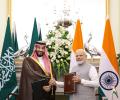
Prime Minister Narendra Modi spoke with Saudi Arabia's Crown Prince Mohammed bin Salman about the ongoing conflict in West Asia, emphasising the need to ensure freedom of navigation and secure shipping lanes.

...is a way out, notes Prem Panicker in his must read blog on the Iran War. What the indefinite extension produces is a prolonged condition of not-war-not-peace, in which oil markets cannot stabilise, Asian refineries cannot plan, European governments cannot stop subsidising consumption they cannot afford, and the next flashpoint -- a seized tanker, a miscalculated drone strike, a Truth Social post that claims too much -- is one news cycle away.

Financial year 2025-26 (FY26) saw a significant shift in corporate fundraising, with rights issues more than doubling to a multi-decade high of 51, raising 44,290 crore, while qualified institutional placements (QIPs) more than halved to 29 issues, mobilising 62,954 crore, driven by sharp equity market corrections and regulatory changes.

Indian equity markets experienced a significant downturn as geopolitical tensions in West Asia, rising oil prices, and foreign fund outflows dampened investor confidence. The Sensex and Nifty both fell sharply in early trade, reflecting broader global market weakness.
 © 2026 Rediff.com - Advertise with us - Disclaimer - Privacy Policy - Sitemap - Feedback - About us - Terms of use - Grievances